

Reviewed by James Farlow (Purdue University Fort Wayne)
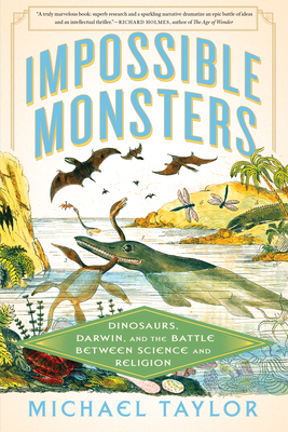
Michael Taylor. 2024. Impossible Monsters: Dinosaurs, Darwin, and the Battle between Science and Religion. Liveright Publishing Corporation, New York. ($32.99 cloth, $21.99 soft.)
Taylor’s preface to Impossible Monsters serves as an admirable extended abstract of the book as a whole: it is “about the discovery of dinosaurs in the nineteenth century and the consequent revolutions that took place in science, religion, and society” (p. xi). Taylor’s account “explores and narrates the first period in human history where new knowledge of the Earth and its prehistoric inhabitants collided seriously and persistently with Christian belief in the accuracy of the Bible (pp. xii-xiii). Taylor contends (p. xii) that his treatment is not “a polemic against scriptural literalism,” the word “battle” in the book’s subtitle notwithstanding. However, “The sincere Christianity of some scientists and the scientific inquiries of some clergymen did not preclude tension between religious belief and scientific evidence; indeed, the very process of reconciling one to the other presupposes an inherent conflict … Science and religion were not implacable enemies, but the nineteenth century still played host to a culture war between the guardians of orthodoxy and the agents of change; there was conflict enough” (p. xx).
Taylor sees this conflict as involving three topics: the age of the earth, the “means of creation” (p. xvii), and “humanity’s relation to other species” (p. xviii). “All three issues feed into one of the defining questions of social, cultural, and intellectual history: secularization” (p. xviii).
Paleontological readers familiar with works by Martin Rudwick, Christopher McGowan, Adrian Desmond, and Hugh Torrens will encounter a familiar cast of characters: Mary Anning, Gideon Mantell, Adam Sedgwick, Roderick Murchison, William Conybeare, Charles Lyell, William Buckland, Robert Grant, Alfred Russel Wallace, Richard Owen, Thomas Huxley, and of course Charles Darwin, among others. It is always great to learn more about these persons, of course, but what I found especially interesting about Taylor’s book is his framing their discoveries and ideas by the changing overall social, cultural, religious, and political “landscape” of Britain in the nineteenth century.
I accordingly appreciated accounts of the ”six acts” (p. 28); the “scriptural geologists” George Bugg and Granville Penn (p. 60); their fellow religious conservatives Sharon Turner (p. 100) and Frederick Nolan (p. 101); the Tractarians (p. 102); the atheistic socialists George Jacob Holyoake and Charles Southwell, and the People’s Charter (pp. 118-120); the doubt-stricken clergyman and early British advocate of German higher criticism of the Bible, James A. Froude (pp. 132ff); the unlucky “Christian Socialist” theologian F.D. Maurice (pp. 166-169); the proponents of “muscular Christianity” (pp. 195-197); and the fiery secularists Charles Bradlaugh and Annie Bessant (pp. 258-261, 292-293, 317-320).
Ichthyosaurs, plesiosaurs, pterosaurs, and of course dinosaurs are the “Impossible Monsters” (to use the delightful term from Charles Kingsley’s [1863] children’s book, The Water-Babies, quoted as the epigraph to the book) of Taylor’s account. Discovery of the fossilized remains of these astonishing reptiles in England in the early-mid 1800s contributed to doubts about whether the biblical book of Genesis was telling the full story of creation. Such doubts had already been prompted by James Hutton’s geological observations that strongly indicated that Archbishop James Ussher’s biblical chronology rather underestimated the true age of the earth.
There was great concern over the course of the nineteenth century that Christianity was losing its religious and moral grip on British society. The excesses of the French Revolution were a frighteningly painful memory. British religious and political leaders were alert to potential threats of something similar happening in their country: “if French revolutionaries were deists or atheists, ‘true Britons’ were bound to defend the Church and its scriptures;’’ hypotheses about earth history had “religious implications…that carried serious social and political risk” (p. 23).
Pioneering geologists were consequently on the defensive against criticisms by conservatives like Bugg, Penn, Turner, and Nolan. Such attacks prompted Buckland to institute lectures on geology at Oxford University; “by bringing geology under the supervision of the ancient university, it would prevent improper inquiries from undermining biblical authority” (p. 27). Buckland’s ideas were developed more fully in his Bridgewater Treatise.
Buckland was not alone in trying to reconcile geological research with the Church of England’s stance on biblical interpretation; he was joined by such prominent workers as Gideon Mantell. The approach was to argue that the days of creation in Genesis were abstract symbols of long periods of geologic time. This worked pretty well, and eventually became uncontroversial.
More threatening to established religion were ideas about species transmutation, which “supposed that the Lord had erred at the moment of Creation: how could animals improve on what was already perfect?” (p. 116). The great French comparative anatomist and vertebrate paleontologist Georges Cuvier had savaged Jean-Baptiste Lamarck’s hypothesis of species change via the acquisition of acquired characters, much to the relief of British naturalists. The irascible Richard Owen used the 1841 presentation in which he defined the Dinosauria, the “pinnacle of reptilian perfection” (quoted on p. 117), as a distinct zoological group, to take his own shot at the idea of species transmutation: “how could any theory of progressive transmutation be correct when the dinosaurs, the most stupendous reptiles ever known, had existed only in the beginning?” (p. 117).
Robert Chambers’ anonymously published Vestiges of the Natural History of Creation (1844), with its explicit support for ideas of transmutation and total rejection of the creation accounts of Genesis, was a sensation that was well received by many, but by no means all, readers. Sedgwick, Murchison, Buckland, and Lyell hated it.
Most troubling of all for British conservatives was the thought that humans might be closely related to other animals. In 1827, none other than Charles Lyell complained to Gideon Mantell that Lamarck’s theories of species transmutation “if pushed as far as it must go…would prove that men may have come from the Ourang-Outang” (quoted on p, 83). Reviewing Vestiges in the Edinburgh Review, Sedgwick argued that the book claimed that the “Bible is a fable when it teaches [readers] that they were made in the image of God… and that they are [instead] the children of apes and the breeders of monsters” (quoted on p. 129). And if humans had evolved (to use the modern term for transmutation) from “lower” animals, this might be political dynamite for the British class system; if animal species could transform into more “advanced” species, then by analogy the stratification of social classes could hardly be justified as Divinely ordained.
Charles Darwin, who was quietly developing his own ideas about the process of species transmutation, was quite alarmed by the reception of Vestiges. Darwin’s theory of evolution by natural selection required no direct Divine action in the creation of new from previously existing species, and he worried that his ideas would be reviled as a blasphemous “Devil’s gospel” (pp. 121, 195). Darwin was finally galvanized into publishing his theory when Wallace shared his independently conceived theory of species transmutation that so closely matched Darwin’s own.
Many naturalists and even Christian clerics applauded On the Origin of Species, published in 1859. Lyell, however, was lukewarm about it, Sedgwick more negative, and Owen, who seems seldom to have tolerated ideas contrary to his own, downright nasty in his criticism. Thomas Huxley of course came vigorously to Darwin’s defense, engaging the Bishop of Oxford, Samuel Wilberforce in a famous confrontation, the details of which regrettably are somewhat murky (pp, 205–206).
Possible implications of Darwin’s theory for human origins were lost on neither naturalists nor clerics. Skeletal fossils of ancient hominins had been found in both Germany and Britain, suggesting considerable antiquity of the human lineage. In 1863, Lyell supported this conclusion in Geological Evidences of the Antiquity of Man, but remained skeptical about derivation of humanity from the apes. Owen and the equally pugnacious Huxley tangled over whether there was a gap in the anatomy of the brain between modern humans and the great apes. In 1863, Huxley published his own book, Evidence as to Man’s Place in Nature, which forcefully argued for derivation of humans from apes. Darwin finally explicitly expressed his own belief in human evolution in The Descent of Man (1871), in which he suggested that humans evolved from African apes—a stunningly prescient hypothesis.
Fossil evidence of transitional forms between species and even higher systematic categories were found in both Europe and North America. The prime example was the toothed basal bird Archaeopteryx, found in Jurassic limestones of Bavaria. Although Owen acquired the famous London specimen for the British Museum in 1862, he explicitly stated that that this was not a transitional form between reptiles and bird, but merely “the earliest known example of a fully-formed bird” (quoted on p. 244). Huxley would have none of that, pointing out similarities between the skeleton of Archaeopteryx and those of the small carnivorous dinosaur Compsognathus. Other primitive toothed birds, Hesperornis and Ichthyornis from the fossil fields of Kansas, were described in 1872 by another strong-willed paleontologist, Yale University’s Othniel Charles Marsh.
Events in Britain showed that the anxiety of political and religious conservatives over secularization of society since the early nineteenth century had not been completely unfounded. The Church of England lost government taxation support in 1868, the Episcopal Church in Ireland was disestablished in 1869, and religious tests for students and fellows at Oxbridge eliminated in 1871. European approaches to biblical higher criticism were becoming better known. And then there were the activities of secularist and atheistic activists, with Bradlaugh becoming a member of Parliament.
The rivalry between Richard Owen and Thomas Huxley continued, with rival institutions of natural history being established in 1881: Owen’s Natural History Museum and Huxley’s Royal College of Science (which became Imperial College). Secular science was now on at least an equal footing with more traditional, even explicitly Christian, ways of understanding nature, and would soon eclipse its former competitor in scientific research institutions.
Scientific research remains methodologically secular and mechanistic in character. I obviously don’t know what the incidence of private religious belief today is among our colleagues. However, I have known several prominent paleontologists who are (or were) theists, and I am open to the possibility myself. It is interesting to note that some at least roughly contemporary natural scientists and theologians have, like Buckland, Mantell, and my own personal hero Edward Hitchcock (of Connecticut Valley dinosaur tracks fame) before them, tried to reconcile Christian theology with the discoveries of science. I note as examples the Anglican physicist John Polkinghorne and the American Catholic theologian John Haught (who builds on the approach of the 20th Century Jesuit paleontologist Pierre Teilhard de Chardin).
I have seldom read a book related to paleontology with greater interest and enjoyment than Impossible Monsters. It is very well written, as the several delightful snippets quoted herein demonstrate. Chapters begin with amusing epigraphs. There are informative black and white figures interspersed throughout the text, as well as an insert of black and white plates.